
- Subscribe
- Premium
- C-Suite
- Insiders
- M&A
- Gurus
- Spinoffs
- Buybacks
- More
Can an economy pick up from where it left off? On February 20, 2020 the market suddenly woke up to the possibility of COVID-19 causing significant disruption to the U.S. economy and over the next seven trading sessions the S&P 500 dropped more than 12% even as trading volume in the SPY shot up significantly as you can see from the chart below.
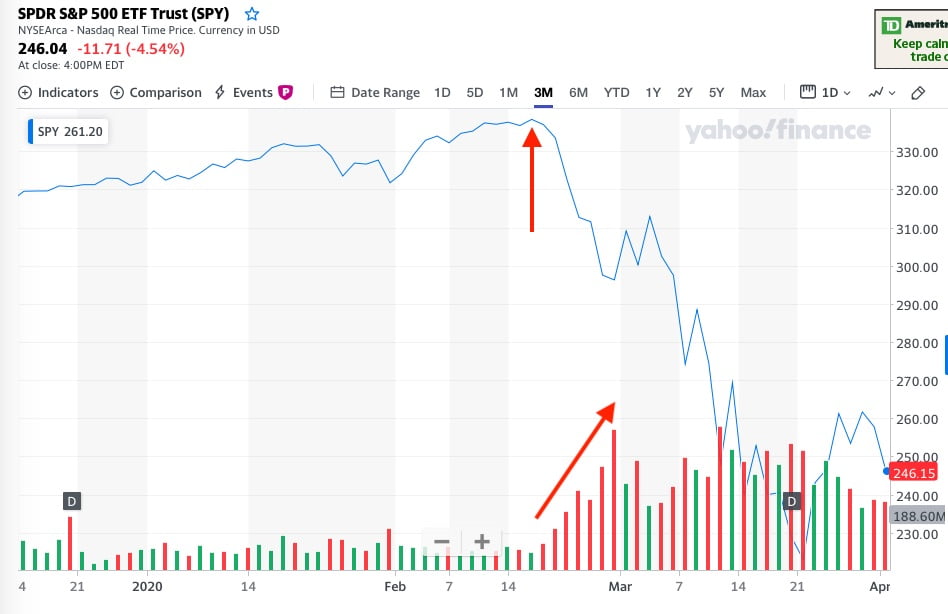
The first phase of the decline occurred just before the CDC confirmed the first case of community spread in the U.S. and the sell off accelerated after a brief respite. We wrote about this in our previous premium post titled The COVID-19 Watch List where we said,
Community spread was a wake up call to local and federal agencies as well as the U.S. stock market. A 50 basis point rate cut from the fed also did not appear to ease fears as the market battled with both the risk of a highly infectious disease and a Bernie Sanders presidency. With Joe Biden taking the lead on Super Tuesday with an estimated 566 delegates (1,991 needed to win the nomination), the market rebounded strongly as at least one of the two key perceived risks appeared to abate.
For me, the canary in the coal mine regarding COVID-19 was when British Airways stopped all flights to mainland China in late January and United and Delta followed suit by the end of the same week. Cutting flights to the second largest economy in the world is not an action taken lightly and I can only imagine the kinds of scenarios the risk management teams of these companies considered before deciding on this course of action.
Getting back to the question of whether an economy can pick up where it left off, it depends on which of the following scenarios play out.
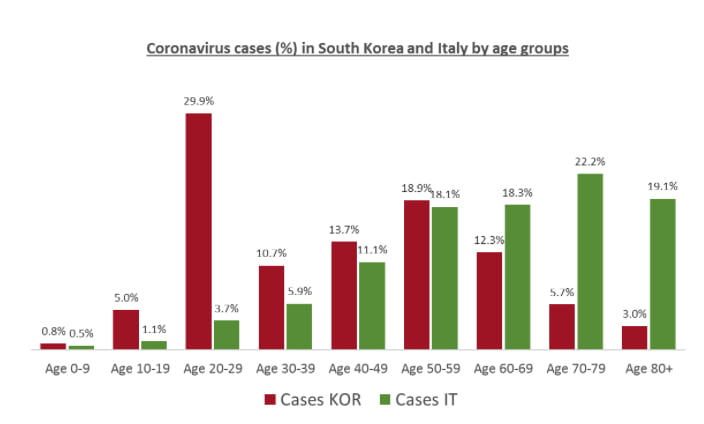
Scenario 1: We experience a large wave of COVID-19 cases and our outcomes are similar to Italy rather than South Korea because our population is demographically similar to Italy and also the slow pace of response in the U.S. as it relates to testing and shutting down non-essential services. However we experience a rapid peak and a quick drop off after that. The impact is felt acutely in Q2 2020 and not much beyond that.
Scenario 1 Probability: I think there is a 60% probability of this scenario playing out.
Scenario 2: We experience a large wave of COVID-19 cases and the impact is spread out through mid-Q3 or end of Q3.
Scenario 2 Probability: 40%
Scenario 3: Following scenario 1, we don’t see a recurrence in Fall or Winter because companies like Moderna Therapeutics (MRNA) or Inovio Pharaceuticals (INO) develop a vaccine and partner with GSK, Merck or Sanofi to produce and deliver the vaccine. It is also possible that one of Gilead’s current anti-virals works for COVID-19 (they have been working with the Chinese government for months) or a cocktail of them will suppress the virus much like they have done with their HIV drugs.
Scenario 3 Probability: I think there is a 75% probability of this scenario playing out. SARS was a Spring 2003 outbreak that mostly ended by early Summer 2003 and MERS was found in the middle east in September 2012 and the outbreak was mostly over by Summer 2013. There was also a two month outbreak in South Korea in May 2015.
Scenario 4: Following scenario 1, we do see a recurrence later this year and early 2021 like we do with the seasonal flu, and the virus mutates. This is the possible worst case scenario (a second darker Black Swan event) and will lead to significant global economic disruption as well as permanent change in the way consumers behave.
Scenario 4 Probability: 25%
The Superforecasters featured in Philip E. Tetlock and Dan Gardner’s excellent book Superforecasting: The Art and Science of Prediction were only right about 66% of the time. It is possible that this situation plays out very differently from the scenarios I have outlined above or that my probabilities are wildly off. As I look at the current turn of events and my portfolio, I realize that the actions taken in the next few weeks are likely to have a significant impact on returns several years down the line.
I wrote the following in our last premium post,
The way I positioned my portfolio for the risks from the COVID-19 virus was to scale back long positions shortly after publishing the February 9th insider weekends post and by purchasing S&P 500 puts expiring in April to hedge the remaining portion of the portfolio. I then purchased out-of-the-money June 2020 put options on Royal Caribbean (RCL). Shorting travel related companies through put options or spreads appeared to be a good hedge. This is especially true for capital intensive businesses with leveraged balance sheets.
Since then I have been unwinding the hedges I put in place more than a month ago, shorted the volatility index and started nibbling on the long side. I also added one more short position by purchasing out of the money July 2020 put options on The Walt Disney Company (DIS).
The COVID-19 playbook I plan to follow over the next few weeks includes,
Considering it is nearly impossible to time market tops or bottoms, I am hoping to spread these purchases out over the course of several weeks or months while course-correcting as needed when new information becomes available.
When considering adding to existing positions or starting new positions I am keeping investment themes in mind including an accelerated shift to streaming services, consumers spending more on gaming and brick-and-mortar retailers losing market share to online/hybrid retailers at a faster pace.
A couple of companies that come to mind when it comes to the increase in streaming theme are Lions Gate Entertainment (LGF) and Discovery (DISCA). Both companies are trading at levels significantly below where insiders purchased these stocks a few months ago. We wrote briefly about Discovery and John Malone’s reasons for buying the stock last November. In the words of the legendary John Malone,
“I believe that they will solve this issue and that they are dramatically undervalued right now. When I put my screen up and I look at companies based upon market cap versus levered free cash flow, they were the cheapest thing on the screen. And I said wait a minute, they are growing in a world where everyone else in shrinking, they own all their content, they are generating a ton of cash, they have an investment grade balance sheet, why are they, why are they cheap.”
In the case of Lions Gate, its director and largest shareholder Mark Rachesky purchased nearly $3.8 million worth of stock at prices below $5 a couple of weeks ago. Dr. Rachesky, a non-practicing M.D. from Stanford worked with Carl Icahn for six years before launching his own fund MHR Fund Management in 1996.
Thanks to its Starz division and the StarzPlay streaming service, the company generates nearly 70% of its revenue from “in home activities” according to a recent research note published by Imperial Capital. Both these companies have a large library of valuable content that is not reflected in their current valuation. We took a deeper dive into Lions Gate last October and you can read that article here. I added to my Lions Gate position this week and plan to increase the position some more in the coming weeks.
Voluntary Disclosure: I hold long positions in Gilead and Lions Gate. I hold short positions via puts in Royal Caribbean (RCL), the S&P 500 index (SPY), Disney (DIS) and the volatility index (VXX).