
This is my fourth annual look back at how things unfolded during the year on three different fronts: personal, business, and investment performance. Last year’s article, 2024: An Eventful Year, can be found here.
Personal
2025 was neither rollicking like 2023 nor eventful like 2024 for me but was quietly transformational. I really enjoyed launching a new podcast with my daughter where we recorded 48 weekly episodes in a row including eight interviews with investors, hedge fund managers and authors. We took a short break for the holidays and plan to start a new season next week.
I was fortunate enough to give guest lectures for students at Columbia University, the University of Wisconsin and the University of Alabama. I was delighted when I was asked to lecture a new batch of students at the University of Wisconsin last year and will be returning for another lecture at the University of Alabama this spring.
I got a chance to learn the game of bridge and have really enjoyed my weekly bridge sessions with a wonderful group of friends. Beyond the social bonds the game fosters, it also stimulates your neurons through improved focus, working memory utilization and calculations of probabilities.
With podcast prep and recording taking up a significant amount of time each weekend, I did not get a chance to read as many physical books as I wanted to in 2025 but three that I managed to read and enjoyed a lot include:
The Joys of Compounding by Gautam Baid
Buffett’s Early Investments by Brett Gardner
Poor Charlie’s Almanac (yes, finally!)
I listened to more podcasts in 2025, but I still find a lot of joy in reading physical books.
My attempts at meditation once again failed. I’ve tried both using meditation apps and without them but it hasn’t quite worked for me.
I fell short on my “non-negotiable” daily goals of learning a new language and working out, and lapsed on those two fronts towards the end of the year. A schedule change from working out in a fasting state in the morning to later in the day combined with several trips to conferences derailed it. I hope to get back on track with them this month.
InsideArbitrage Business
The line “The best laid plans of mice and men go awry” from Robert Burns’ poem pretty much sums up 2025 on the business side for me. I wrote the following in last year’s annual lookback:
“I had the ambitious goal of growing InsideArbitrage revenue by 50% in 2024 after exceeding my 35% growth target in 2023. Unfortunately, this year I fell far short of that goal and revenue grew 31%. My target for 2025 is 30% revenue growth.”
We continued to expand the service by adding:
These enhancements to the product were not sufficient to offset the impact a very difficult year for the merger arbitrage strategy in 2024 and the tariffs related market weakness in early 2025. Instead of growing 30%, revenue declined by 8% in the first half of 2025.
Things started to improve in the second half of the year but it was not enough to get us back to positive territory and we ended 2025 with our first annual revenue decline of 2%.
My target for revenue growth in 2026 is a more modest 10% in a base case scenario and 25% if things go according to plan.
InsideArbitrage Model Portfolio Performance
The model portfolio generated returns of 10.89% in 2025 without taking dividends into account.
What worked?
Some of the things that worked for us on the long side include catching a rocket ship through the spinoff of SanDisk (SNDK) by Western Digital (WDC), which we participated in before the spinoff occurred. I discussed my thesis about the spinoff on Rich Howe’s first Stock Spinoff Investing podcast here (at the 25.25 minute mark).
The thesis was the same one that helped us benefit from buying GE before the GE Vernova (GEV) spinoff. The parent Western Digital generated gains of 207% by the end of 2025 and SanDisk generated gains of 388%. SanDisk went parabolic this month and is now showing gains of over 649% in the model portfolio.
Our investment in satellite-based wireless connectivity provider Globalstar (GSAT) also caught a bid and we ended the year with gains of 190% in that position thanks to a large investment by Apple into the company. We found the company on account of significant insider purchases by the Chairman of the company in late 2024 and the first half of 2025.
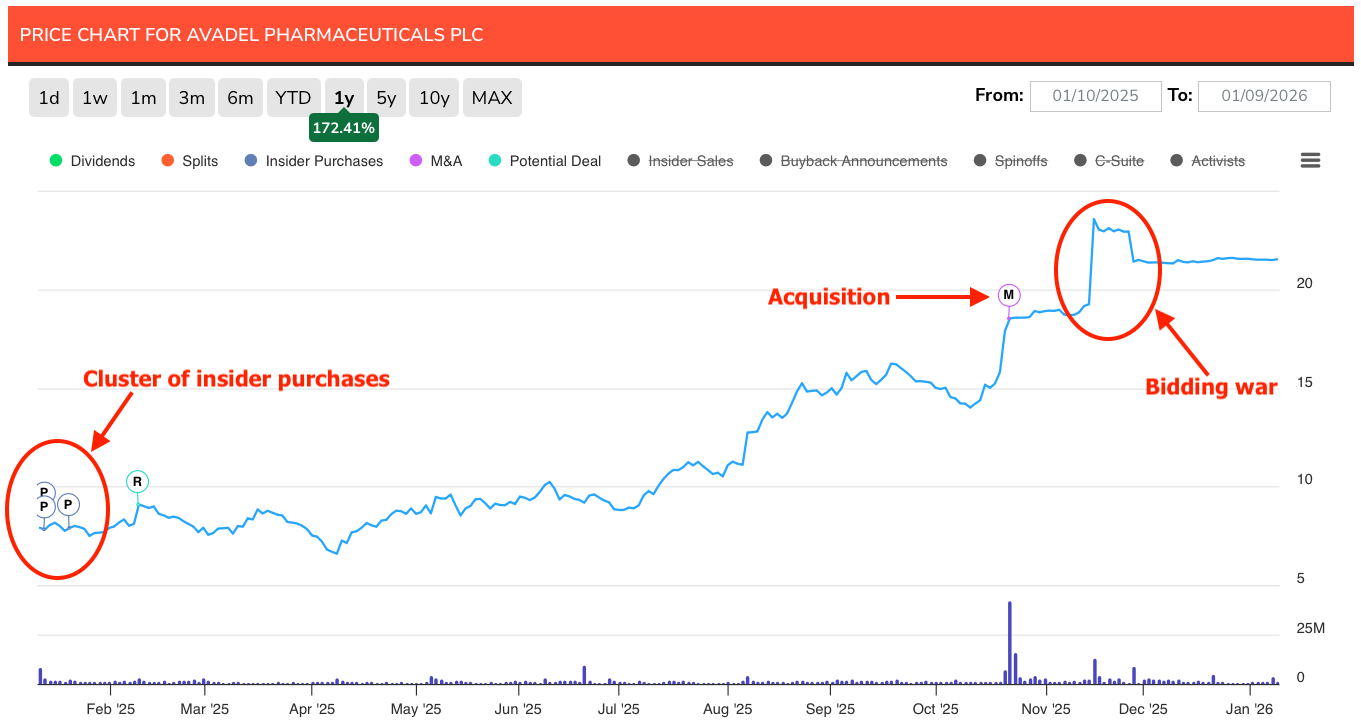
Other positions that worked for us and that we exited include Avadel (AVDL) after it was acquired by Alkermes (ALKS) and a post-merger announcement bidding war ensued. The position generated a gain of 139%. We found Avadel thanks to a cluster of insider purchases (something we were seeing across the biotech sector early last year) and the company ranking very high on our quantitative model.
We also did well with a gain of over 50% in Guess (GES), which was one of our “deals in the works” situations that ended up with a definitive merger agreement. Every April we look at our database of deals in the works and pick two potential deals we find interesting and also do an in-depth quantitative analysis of the data, which now spans over nine years and more than 1,000 deals.
To round things up, we exited SoFi (SOFI) with gains of 137%, a company that we had on our watchlist for more than three years after CEO Anthony Noto’s insider purchases and finally decided to add to the model portfolio in 2024.
What didn’t work?
We learn more from what did not work and the losses we take hopefully help us improve our process going forward. A lot didn’t go right for the model portfolio in 2025.
Short positions, which provided significant positive contributions to the model portfolio in 2024 when GameStop and Energy Vault Holdings cratered more than 90% from our short price, had the opposite impact in 2025. Carvana (CVNA), which initially went in the right direction for us, ended up on a rocket ship of its own and we were caught on the wrong side of it. By the time we decided to exit that short position, the loss on Carvana was 290%.
Beyond avoiding short positions altogether and improving position management, another key lesson was to sidestep companies that are caught in strong upward momentum and where the elevated stock price creates significant optionality for the company, as we have seen with Tesla and more recently Carvana.
Early in 2025, before the regulatory environment turned positive for mergers and acquisitions, we also took losses in our merger arbitrage position related to Capri’s (CPRI) failed acquisition by Tapestry (TPR).
Unfortunately, because of this experience and the failed Spirit Airlines deal, I reduced my exposure to the merger arbitrage strategy just as we should have doubled down on it. The strategy worked very well in 2025 and the regulatory environment has become so favorable that spreads have compressed significantly for most active M&A situations.
The last eight years of operating InsideArbitrage and managing a model portfolio have taught me a lot. Each year we surface more than 100 ideas across the six strategies that we track including merger arbitrage, insider transactions, stock buybacks, spinoffs, C-suite transitions and SPACs.
We plan to continue to improve the platform through the addition of new tools and strategies, while providing accurate and actionable information through our detailed write-ups of those more than 100 ideas.
Disclaimer: Please do your own due diligence before buying or selling any securities mentioned in this article. We do not warrant the completeness or accuracy of the content or data provided in this article. I hold a long position in Avadel.