
- Subscribe
- Premium
- C-Suite
- Insiders
- M&A
- Gurus
- Spinoffs
- Buybacks
- More
Nassim Nicholas Taleb, the author of Fooled by Randomness, certainly seems to think so based on what he tweeted yesterday:
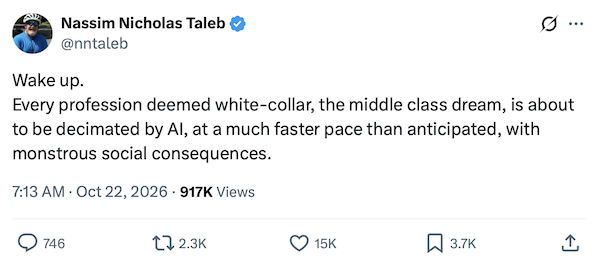 Earlier this week I was listening to the wonderful interview with Ken Griffin at the Annual Citadel Securities Conference and there were a couple of parts that jumped out at me. One of them aligns with what Taleb is saying about the coming collapse in white collar jobs and in another part he seemed to offer some hope for Wall Street analysts.
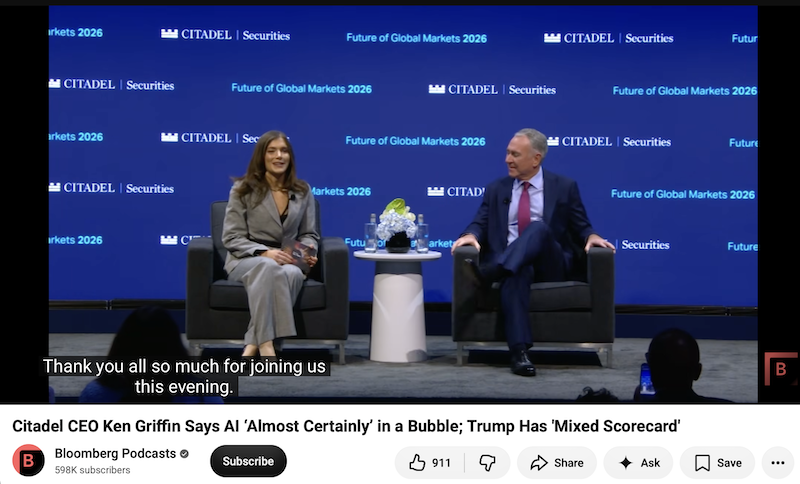
In one segment of the interview Ken says:
“I did give a speech or a talk at Stanford, where I discussed the fact that work that used to take our PhDs and Masters four to six weeks to complete, high level white collar jobs, press a button on a keyboard, wait a few hours, there’s the exact same answer.
And I will tell you that when I went home after seeing this, it was a Friday, it was actually it was a very depressing moment. Because you’re seeing all kinds of things, right? You’re seeing the threat to white collar jobs playing out. As a business owner, you’re seeing your competitive moats be filled in by bulldozers.”
He goes on to say that there will be winners including entrepreneurs who are starting new businesses that leverage the power of AI.
Another part of the interview that I found fascinating was when he said:
“But ultimately, I still firmly believe that the vast majority of the alpha that we create is a statement or testament to the two the creativity, the ingenuity, the analysis of the people on our team who conduct fundamental research. And then trading is how we monetize that.”
We use AI extensively at InsideArbitrage and it has helped when it comes to tasks like data ingestion (adding discrete data to our database from SEC filings), writing code and editing articles. I still personally continue to write all my content and only use AI as an editor for spelling, grammar and clarity related issues.
On the analysis side, I’ve found it incredibly useful in some instances and outright wrong at other times.
Let me provide an example of each.
AI Analyst – Opportunities
Earlier this year, a hotel REIT called Sotherly Hotels was acquired by a fund affiliated with the family that started Holiday Inn and Los Angeles-based Ascendant Capital. The buyers paid a hefty 150% premium to acquire this hotel operator. While the merger arbitrage spread on the deal was just 4.65% at the start of this year, the annualized yield worked out to 18.86% assuming the deal closed by March 31, 2026.
For investors that participate in merger arbitrage this is an attractive return. However I noticed something else about this deal that really got me excited. My initial calculations pointed to a potential return of nearly 40% (not annualized).
Considering I have been looking for opportunities in M&A deals for over sixteen years, something felt intuitively wrong. The markets rarely provide a free lunch and when they occasionally do, it is rarely a feast befitting a king.
I used multiple frontier AI models to check what was missing and one of them picked up a clause in a prospectus from 2017 that showed that the potential return was a little over 10% and not 40% based on my quick calculations. I was considering the first clause in a section of that prospectus but the AI model pointed out that it was the second clause that applied in this situation.
A 10% return in about three months was still attractive and I ended up participating in the situation after writing about it in the January 2026 Special Situations newsletter.
AI Analyst – Limitations
In a more recent example, multiple frontier AI models came to the wrong conclusion about a potential deal situation or “deals in the works” as we like to call them.
On October 13, 2026, Ithaca Holdings announced that they were acquiring the dating app Bumble for $1.3 billion or $6.05 per share in cash. Bumble was a spotlight idea for our August 2026 Special Situations newsletter when the stock was trading at $2.85 and we wrote the following summary of the situation:
Bumble, the dating app company, has seen its stock decline more than 95% from its first day closing price of over $70 per share following its IPO in February 2021.
Whitney Wolfe Herd, who was part of the founding team of Tinder before starting Bumble, returned as a boomerang CEO in March 2025.
Revenue and paying users at both the main dating apps of the company, Bumble and Badoo, continue to decline but adjusted EBITDA and free cash flow have improved rapidly.
The company is exploring a sale and hired Morgan Stanley as its financial advisor, according to a Reuters news report in late June.
The structure of their credit agreement to refinance debt in April points to a potential acquisition in the near term.
We have been tracking “deals in the works” for almost nine years and every April we analyze our data for insights. This April, I looked at 1,109 rumored deals and found that 42.56% of these situations result in an actual deal. There were a bunch of other insights I shared in that April 2026 newsletter but I’ll spare you the details.
What is worth mentioning however is that I used multiple frontier AI models when looking into the Bumble situation primarily because I was trying to understand the terms of a debt refinancing the company completed just weeks before Reuters reported that Bumble was looking to sell itself.
As an equity investor, I am not as well versed about credit as I should be and I am in the process of fixing that by reading The Credit Investor’s Handbook by Michael Gatto. I figured the frontier models would help me understand the refinancing and determine if the way it was done was indicative of a deal occurring in the near future.
The AI models seemed to indicate that the debt refinancing was net negative and made a potential deal less likely. The more I dug into the situation, the more I disagreed with that conclusion. Here is what I wrote about the refinancing in the August newsletter:
“The Strange New Debt Structure
The second and more important part was the company’s decision to refinance $587.50 million worth of debt that was coming due in 2027. I am not a credit investor but the conditions related to the new debt only made sense if the company expected an acquisition in the near-term or had confidence in its cash generation capabilities over the next two years.
Bumble used $112.50 million of cash on its balance sheet to pay down some of the debt and took on only $475 million of new debt on April 24, 2026. The new debt was from special situations firm STORY3 Capital and Guggenheim. Just nine weeks after this refinancing, Reuters reported the company was exploring a sale. The part that surprised me was not that this new debt appeared to be a high 11.60% rate (800 basis points over SOFR) compared to the prior debt’s 5.40% rate, which happened during the era of near zero interest rates.
It wasn’t the covenants related to the maximum leverage the company could have (3X EBITDA as of September 30, 2026 and then gradually going down from there) or the consolidated liquidity the company needed to maintain.
The part that surprised me was the prepayment penalty and the aggressive mandatory loan amortization. Bumble has to pay monthly installments of roughly $5 million from July 2026 through June 2027 and then just shy of $6 million per month from July 2027 onwards. The remaining balance of about $220 million is due on April 24, 2030.
If for some reason Bumble voluntarily attempts to pay down the debt, they have to pay the following penalties:
1. Through April 2028: Principal plus 4% of principal as well as the present value of scheduled interest through April 24, 2028 on the principal being repaid.
2. After April 24, 2028 but before April 24, 2029: 4% of the principal that was prepaid. Beyond this prepayment penalty, the credit agreement also included mandatory prepayment sweeps where the year-end leverage is more than 1.75X EBITDA, then 75% of annual consolidated excess cash flow must be applied to the term loan. If the leverage is 1.75X or less, then 50% of cash flow must be applied to the term loan. You can check out the full credit agreement here.
Yes, there was a huge debt repayment coming up for Bumble in January 2027, but given the amount of free cash flow the company was generating in 2025, the terms of this credit agreement for the new debt seemed overtly one-sided. A CEO accepting terms like this is only doing so because the business is in very rapid decline or they expect to pay down this debt in the short-term. The retention of Morgan Stanley as Bumble’s financial advisors just weeks after this credit agreement points to the latter.”
I am glad I decided to rely on human intuition in this case and it helped both the model portfolio and my personal portfolio generate returns of over 100% in less than three months.
How Will The Future Unfold?
I completely agree with Ken Griffin that analysts who approach their jobs with creativity, ingenuity and hard work will continue to thrive in this new AI-powered world.
The part that leaves me worried is that two years ago, none of the AI models could do anything close to what I experienced with the Sotherly Hotels and Bumble situations. If the new models that show up in 2027 and 2028 move the needle further, will creativity and ingenuity be enough for analysts to retain their jobs?
I don’t know the answer and the “reskilling” solution offered often rings hollow. Nassim Nicholas Taleb and Ken Griffin are rightfully concerned.
Disclaimer: I hold a long position in Bumble (BMBL). Please do your own due diligence before buying or selling any securities mentioned in this article. We do not warrant the completeness or accuracy of the content or data provided in this article.