
- Subscribe
- Premium
- C-Suite
- Insiders
- M&A
- Gurus
- Spinoffs
- Buybacks
- More
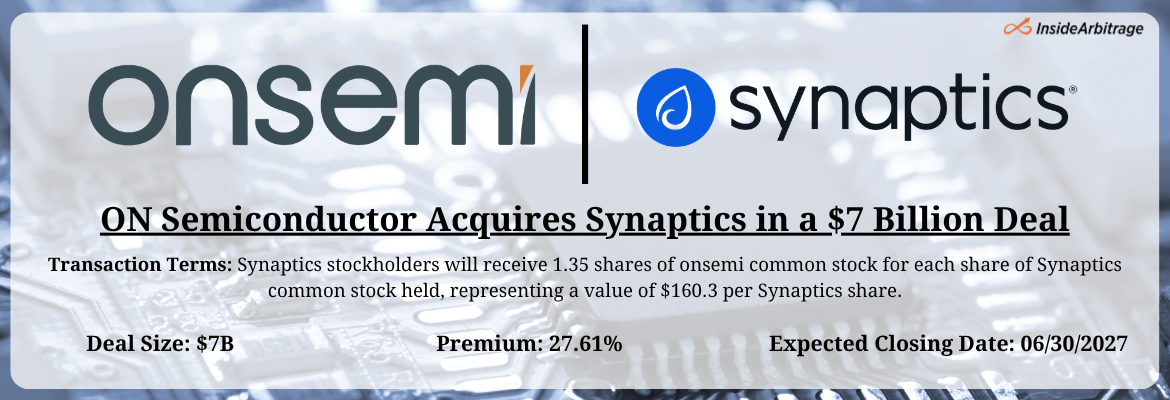
ON Semiconductor Corporation (ON) entered a merger agreement on June 25, 2026, to acquire Synaptics Incorporated (SYNA) in a deal valued at $7 billion.
Synaptics stockholders will receive 1.35 shares of onsemi common stock for each share of Synaptics common stock held, representing a value of $160.3 per Synaptics share, at a 27.61% premium from the stock’s last close.
Synaptics is a semiconductor company that develops connectivity, sensing, and edge AI solutions for consumer, PC, IoT, and automotive applications. The company provides wireless connectivity, multimedia processing, biometric sensing, display, and human interface technologies to OEMs worldwide.
ON Semiconductor is a semiconductor company that develops power management, analog, and sensing solutions for automotive, industrial, data center, and energy applications. The company provides power devices, image sensors, and integrated circuits used in electric vehicles, industrial automation, energy infrastructure, and advanced imaging systems.
One member of Synaptics’ Board is expected to join onsemi’s Board.
The closure of this merger is anticipated in mid-2027.
Synaptics received financial advice from Qatalyst Partners and legal advice from Baker McKenzie. Meanwhile, ON Semiconductor received financial advice from Morgan Stanley and J.P. Morgan Securities, and legal advice from Skadden, Arps, Slate, Meagher & Flom.
ON Semiconductor is paying 59.87 times EBITDA for Synaptics.
For more comprehensive information about this M&A transaction, please visit the Deal Metrics page at the following link:
Deal Metrics for the acquisition of Synaptics Incorporated (SYNA) by ON Semiconductor Corporation (ON)
The Deal Metrics page provides in-depth details about each merger or acquisition, including:
Disclaimer: This article is intended for informational purposes only. It is recommended to conduct your own due diligence before buying or selling any securities mentioned in this article. The completeness or accuracy of the content or data provided in this article are not warranted.
Editor’s Note: Baranjot Kaur contributed to this article