
- Subscribe
- Premium
- C-Suite
- Insiders
- M&A
- Gurus
- Spinoffs
- Buybacks
- More
Over the past year, fears that generative AI could disrupt traditional SaaS have weighed heavily on software stocks. Stocks like Asana, Salesforce, AppLovin, Twilio, and ServiceNow have all seen sharp selloffs over the past year, and Klaviyo (KVYO) is no exception. The stock recently hit an all-time low and is down nearly one-third over the past year as investors worry AI could threaten CRM and customer engagement vendors.
But that framing may be far too simplistic. Management has been clear that AI should enhance, not weaken, Klaviyo’s position. Andrew Bialecki, co-founder and co-CEO, commented in this context,
“The future of consumer engagement is autonomous, and brands are choosing Klaviyo because real-time data, personalization and automation together deliver faster execution, higher-quality experiences, and clear economic upside. The upshot is that AI is an accelerant and opportunity for our customers and for us.”
Management appears to have used that disconnect to its advantage, authorizing a $500 million share repurchase, equal to about 9% of its market cap at the time of the announcement, while also launching a $100 million accelerated share repurchase. That combination of market skepticism, resilient fundamentals, and decisive capital allocation is exactly why Klaviyo stands out as the top contender for a deep dive in our latest article on buyback announcements.
Klaviyo, Inc. (KVYO): $20.10
Market Cap: $6.25B
Enterprise Value: $5.3B
Key Insights
Founded in 2012 and based in Boston, Klaviyo is a SaaS company that provides a purpose-built B2C CRM platform for consumer brands. It combines first-party data, marketing automation, analytics, and AI-driven personalization to help businesses manage email, SMS, WhatsApp, push notifications, and, increasingly, customer service from a single platform.
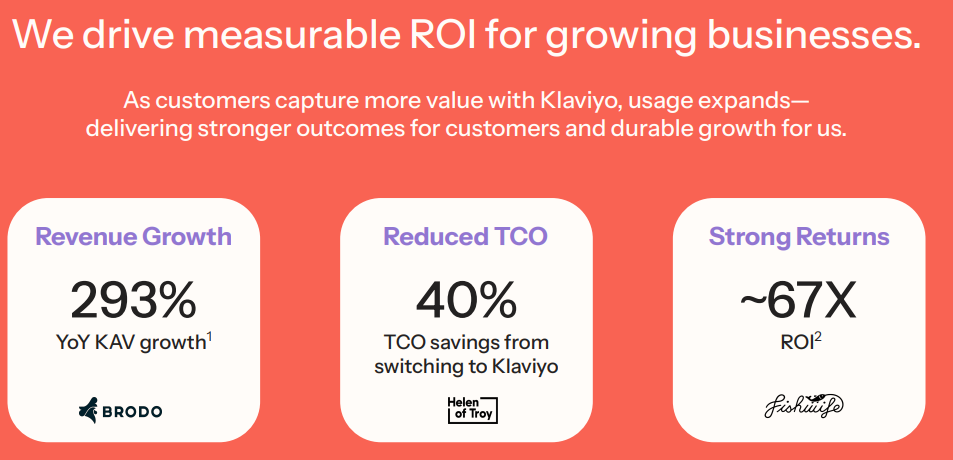
Klaviyo generates almost all of its revenue from subscriptions using a usage-based model tied to active consumer profiles, message volume, and service activity rather than seat-based pricing. This model creates a natural revenue expansion dynamic: as a merchant’s customer base grows, so does what they pay Klaviyo.
Source: Klaviyo (Earnings Presentation)
What sets Klaviyo apart from generalized CRMs like Salesforce (CRM) or HubSpot (HUBS) is its purpose-built focus on B2C workflows. The platform prioritizes inbound, data-driven marketing over field sales and is designed for the high-volume, fast-paced reality of consumer businesses where speed, personalization, and measurable ROI matter most.
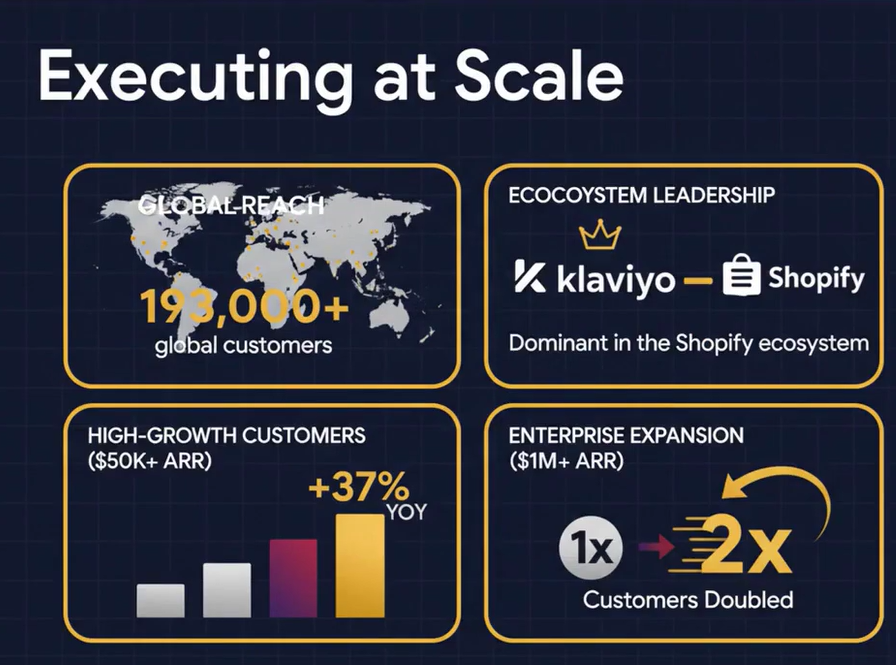
The platform integrates with over 350 third-party tools, with Shopify being the most critical partner. Approximately 78% of Klaviyo’s total ARR is derived from Shopify merchants. Klaviyo started in e-commerce and has since organically expanded into verticals such as education, events and entertainment, restaurants, travel, and B2B use cases.
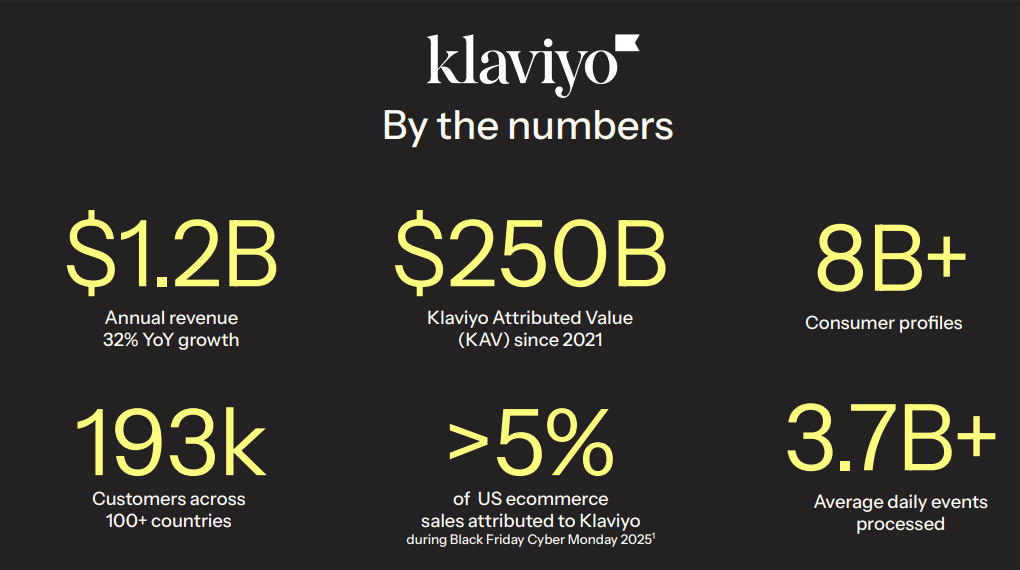
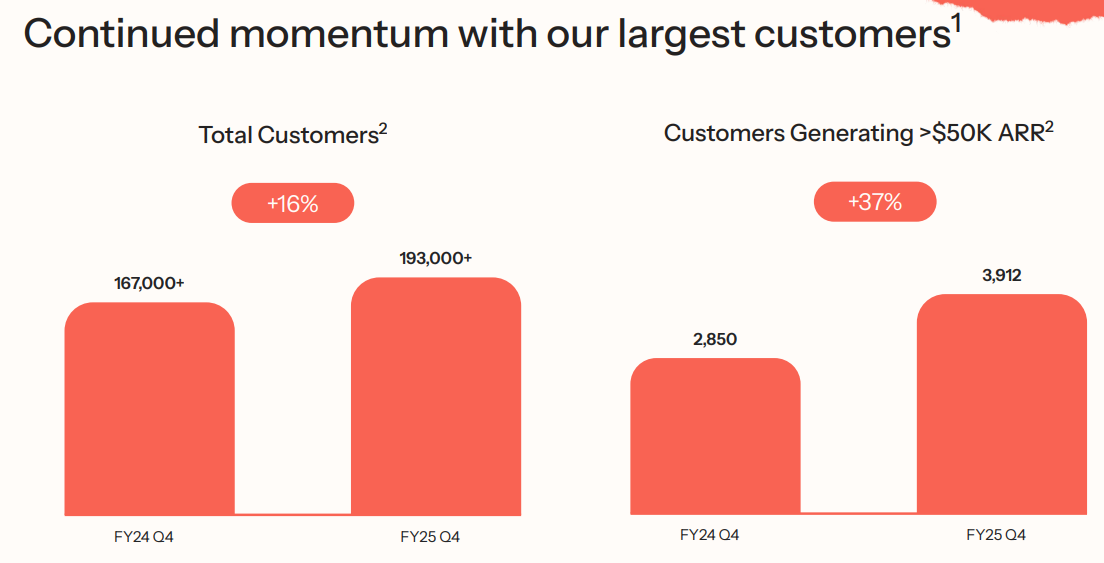
The company now serves more than 193,000 customers in over 100 countries, and its largest customers continued to perform well, with the top 10,000 growing GMV (Gross Merchandise Volume) by 11% in Q4, roughly double the broader market’s pace.
International Expansion and Channel Mix
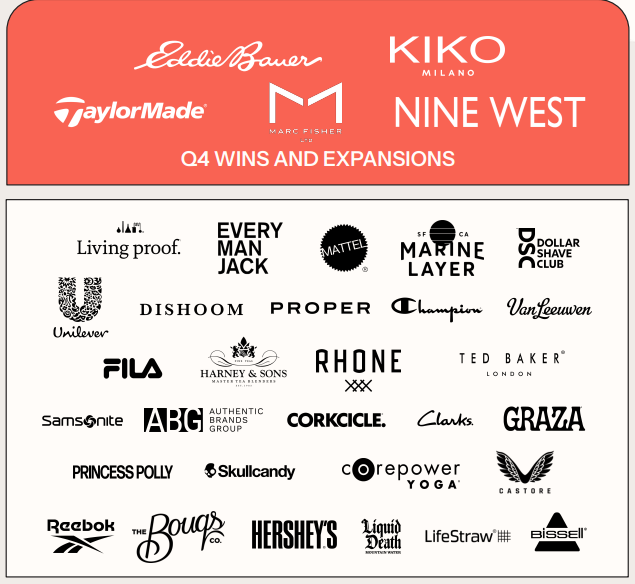
International revenue now accounts for more than one-third of Klaviyo’s total revenue. In the latest quarter, it grew 42% year over year, well ahead of the broader business and faster than the Americas. New regional hubs in Dublin and Singapore are supporting this expansion and strengthening the company’s operating footprint in what remains a largely underpenetrated market. During the quarter, Klaviyo also partnered with KIKO Milano, Italy’s leading makeup brand, which operates more than 1,300 stores across 70+ markets worldwide.
Source: Klaviyo
The more important mix shift is happening at the channel level. Klaviyo is gradually evolving from a primarily email driven business into a broader messaging platform, with 29.6% of SMB customers using text messaging and WhatsApp at year end 2025, up from 26.1% a year earlier.
This matters for margins. Email is nearly pure software margin, while every text message carries a carrier pass-through cost that Klaviyo cannot avoid. This is the core reason GAAP gross margins compressed 170 basis points to 74.7% in FY 2025, and why they will likely continue drifting lower as SMS adoption scales.
Klaviyo is expanding beyond marketing into service and analytics, which should increase wallet share and improve retention if management executes well. That gives the company a path to offset some margin pressure with broader product depth and a more durable platform relationship.
Klaviyo’s Co-CEO Structure
Klaviyo is led by two co-CEOs: co-founder Andrew Bialecki, who previously served as CEO, and Chano Fernández, appointed on December 9, 2025, effective January 1, 2026.
The co-CEO model is rare, but Klaviyo’s version has a clear rationale. Andrew Bialecki is a deeply technical, product-obsessed founder whose strengths lie in platform architecture, AI strategy, and innovation. But Klaviyo is no longer a startup. It’s a $1.2 billion-revenue public company that is aggressively pushing into enterprise, expanding globally, and transforming from a marketing tool into a full B2C CRM. That requires a very different skill set. Chano Fernández, who was co-CEO at Workday and held senior roles at SAP, brings exactly that: deep experience scaling enterprise go-to-market organizations, international operations, and operational rigor. He had also served on Klaviyo’s board for the prior two years, so the transition was not abrupt.
Several major companies have adopted co-CEO structures in recent years. Netflix (NFLX) has operated with Ted Sarandos and Greg Peters as co-CEOs since 2023, splitting content and marketing from product and technology. In 2025, Spotify (SPOT) named Gustav Söderström and Alex Norström co-CEOs effective January 1, 2026, while Comcast (CMCSA) promoted Michael Cavanagh to serve alongside Brian Roberts in a dual leadership structure. Oracle (ORCL) also adopted a co-CEO model in 2025, appointing Clay Magouyrk and Mike Sicilia, indicating that paired leadership is increasingly used to balance technical, operational, and commercial priorities at scale.
Total Addressable Market
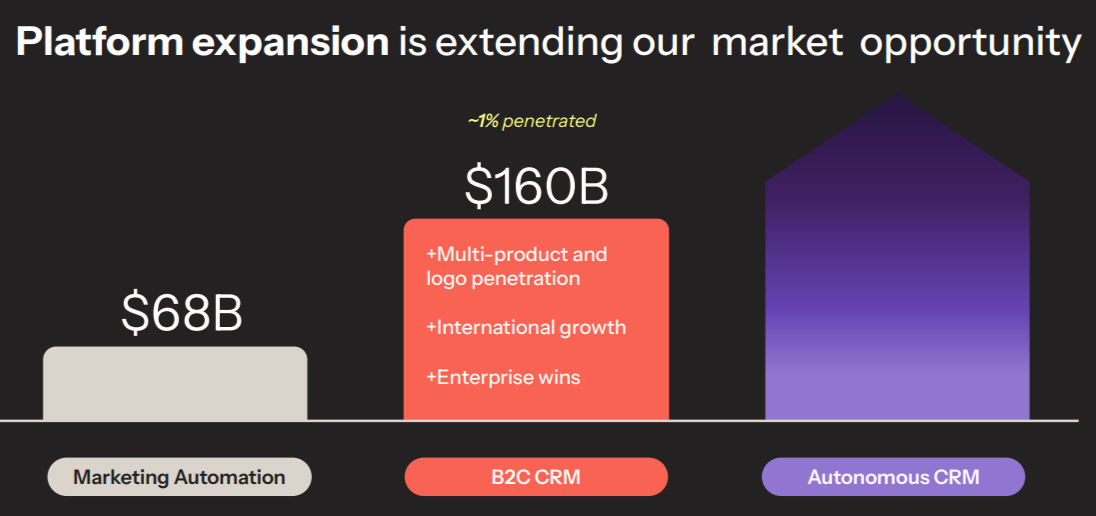
Klaviyo previously estimated its total addressable market (TAM) for marketing automation at roughly $68 billion. With the company’s evolution into a broader B2C CRM platform, the opportunity is expected to expand significantly, with management projecting a global TAM of about $160 billion by 2026.
The increase is driven by deeper penetration within existing customers, international expansion, and improving traction with larger, more sophisticated brands. Even against this larger opportunity set, management believes Klaviyo’s current penetration remains only around 1%, underscoring the runway the company may still have for long-term growth.
Source: Klaviyo (Earnings Presentation)
Valuation
At a share price of $20.1, Klaviyo has a market cap of approximately $6.25 billion. The company holds $944 million of net cash. This brings the enterprise value to around $5.3 billion. On forward estimates, the stock trades at approximately 23x forward P/E and 22x forward EV/EBITDA, which is not outright cheap. However, for a company expecting to deliver 20%+ revenue growth, with trailing 15% non-GAAP operating margins, 16% free cash flow margins, and an improving NRR of 110%, these multiples appear reasonable rather than stretched. Had it not been for the threat of disruption from AI or the Shopify partnership risk, one could even go so far as to say the company is cheap.
Profitability
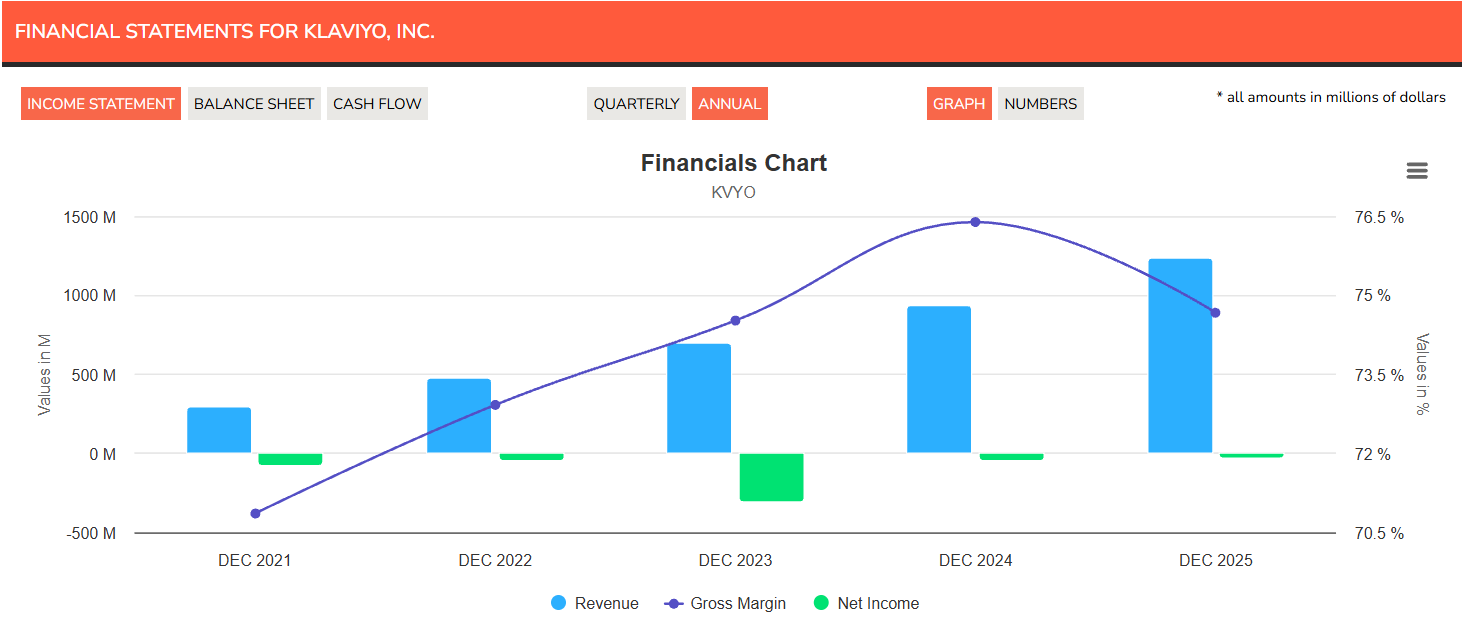
Klaviyo has gradually increased revenue each quarter but has not achieved profitability until recently. Q4 2025 was a milestone quarter. Klaviyo reported its first-ever GAAP net income of $7 million, a meaningful inflection point for the company. Full-year GAAP net loss narrowed to $31.8 million, down from $308 million in FY 2023, and the trajectory toward sustained annual GAAP profitability is now clearly visible.
Source: InsideArbitrage
On a non-GAAP basis, the economics are already strong. Operating margins expanded to 15% in Q4 and 13.7% for the full year, while free cash flow reached $189.5 million, a 16.2% FCF margin. On “The Rule of 40”, which looks at a combination of revenue growth and operating margin, Klaviyo scores a 48, comfortably above the benchmark and indicative of a business that is balancing growth and profitability well.
That said, the gross margin trend deserves close attention. Cost of revenue has more than doubled over the past two years, and GAAP gross margins have declined from roughly 78% to 72% over the same period as the revenue mix shifts toward SMS and WhatsApp. These channels carry significantly higher outbound delivery costs, which grew 41% year over year in FY 2025, outpacing revenue growth. This is not a temporary phenomenon. It is structural, and gross margins are expected to continue tapering.
For context, Twilio’s (TWLO) actual reported GAAP gross margin was 50% in 2024 but dipped to 48% in 2025. This is mostly because Twilio pays telecom carriers and platforms significant fees for each message sent (often 70-80% of the revenue from that transaction goes to those pass-through costs).
Acquisitions
Klaviyo has been highly disciplined on M&A, making just two small acquisitions in more than a decade. It acquired Napkin.io in 2022 to bolster developer capabilities and Gatsby in 2025 to bring social interactions like DMs, tags, and mentions into owned channels such as email and SMS. Neither deal was large, but both were strategically aligned with Klaviyo’s goal of building a broader customer lifecycle platform.
Key Partnerships
The most important commercial relationship by far is with Shopify (SHOP). In 2022, Shopify made a $100 million strategic investment in Klaviyo and designated it as the recommended email solution for Shopify Plus merchants. Today, approximately 78% of Klaviyo’s total ARR flows through the Shopify ecosystem. The collaboration agreement runs through 2029, and its renewal will be a critical valuation event that investors should track closely.
Beyond Shopify, Klaviyo has been building out a roster of high-profile partnerships. In 2025, the company partnered with Accenture Song to deliver AI-powered CRM solutions for large enterprise brands such as Stanley 1913, reinforcing its upmarket push. In February 2026, Klaviyo announced a strategic partnership with Google, integrating Google Search, Ads, AI, and RCS messaging directly with Klaviyo’s real-time data platform.
Klaviyo also launched its app inside ChatGPT in January 2026, giving marketers direct in-chat access to campaign data, performance insights, and recommendations. The integration is still early, but it reinforces management’s effort to position Klaviyo as a more AI native platform rather than a company being displaced by AI.
Peer Comparison
Klaviyo’s closest public peers are Braze (BRZE), Twilio (TWLO), and Sprinklr (CXM), although each occupies a slightly different position within the customer engagement software landscape. Braze is more focused on large enterprise customers and mobile app engagement, while Klaviyo has built its franchise in ecommerce and the mid-market with a more integrated and easier-to-implement platform.
Despite that positioning, Klaviyo’s stock has generally underperformed its peers over the last three years. At the same time, it still trades at a valuation premium on forward EV to sales, at about 3.6x, the highest in the group, compared with roughly 3.2x for Twilio.
The premium is largely supported by growth and higher gross margin. On the latest reported numbers, Klaviyo delivered 32% revenue growth in 2025, well ahead of Braze at 23%, Twilio at 14%, and Sprinklr at 6.5%, making it the fastest-growing company in the peer set.
Klaviyo also compares favorably in terms of business quality. The company is already generating meaningful free cash flow and posted its first GAAP-profitable quarter in Q4 2025, while Braze remains GAAP unprofitable and Twilio is only marginally profitable, with a net margin of less than 1%. Sprinklr stands out as the most profitable of the group, with a net income margin above 13%.
Capital Allocation
Klaviyo has not historically been particularly shareholder-friendly in terms of capital returns. It pays no dividend and has never announced a share repurchase before the latest $500 million buyback, which makes the move encouraging, but not entirely straightforward. Given that shares outstanding have increased about 36% in the last four years and stock-based compensation remains elevated at $162 million, or 13% of revenue, a meaningful portion of the buyback may simply offset dilution rather than deliver a true reduction in share count. If it hadn’t been for the accelerated part of the buyback program, we would not have picked Klaviyo for this month’s Buyback Wednesdays article.
Insider Activity: Heavy Selling, But One Notable Buy at the Lows
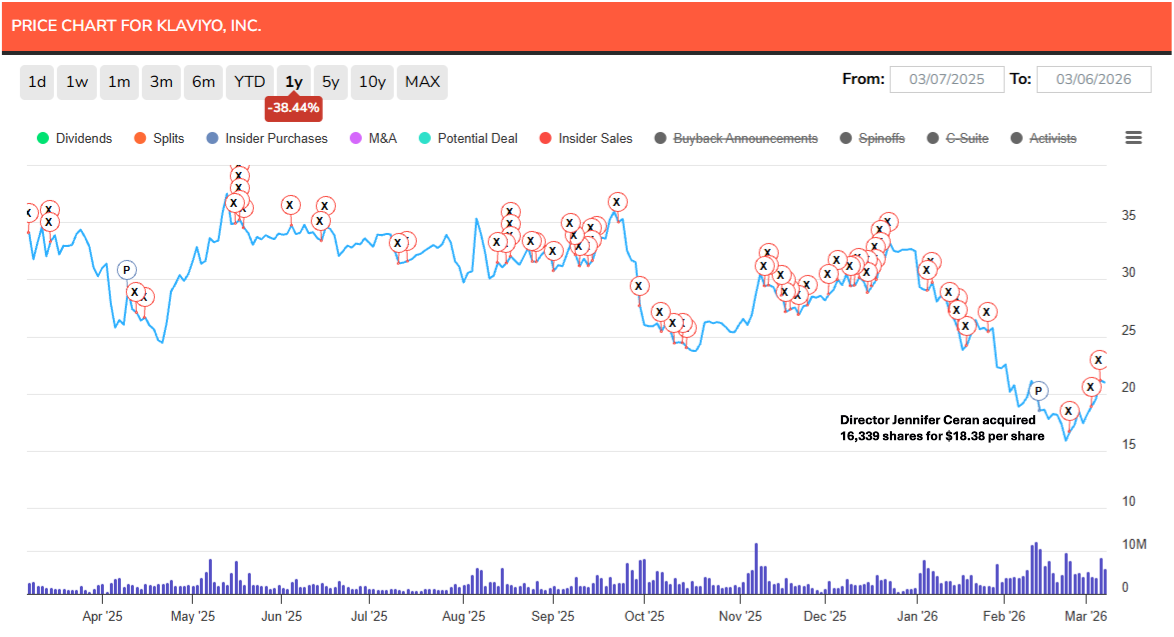
Insider buying is generally viewed as a green flag since insiders have the best visibility into where a business is heading. At Klaviyo, open market purchases have been rare. Over the past six months, insider activity has been overwhelmingly skewed toward selling: 71 insider trades were recorded, of which 70 were sales (much of which is likely pre-planned 10b5-1 activity related to stock compensation), and only one was a purchase. The lone buyer was director Jennifer Ceran, who purchased 16,339 shares on February 12, 2026, at $18.38 per share, spending roughly $300,000 and bringing her share count to 24,871, nearly tripling her actual shareholding (She held 8,532 shares of Series A Common Stock plus 5,820 unvested RSUs before the recent purchase).
Ceran is a seasoned finance executive who previously served as CFO of Smartsheet, so she understands how to read the tea leaves of a SaaS business. Her timing is notable: the purchase came just two days after the strong Q4 earnings report and while the stock was still near its 52-week lows.
Source: InsideArbitrage
Q4 Results
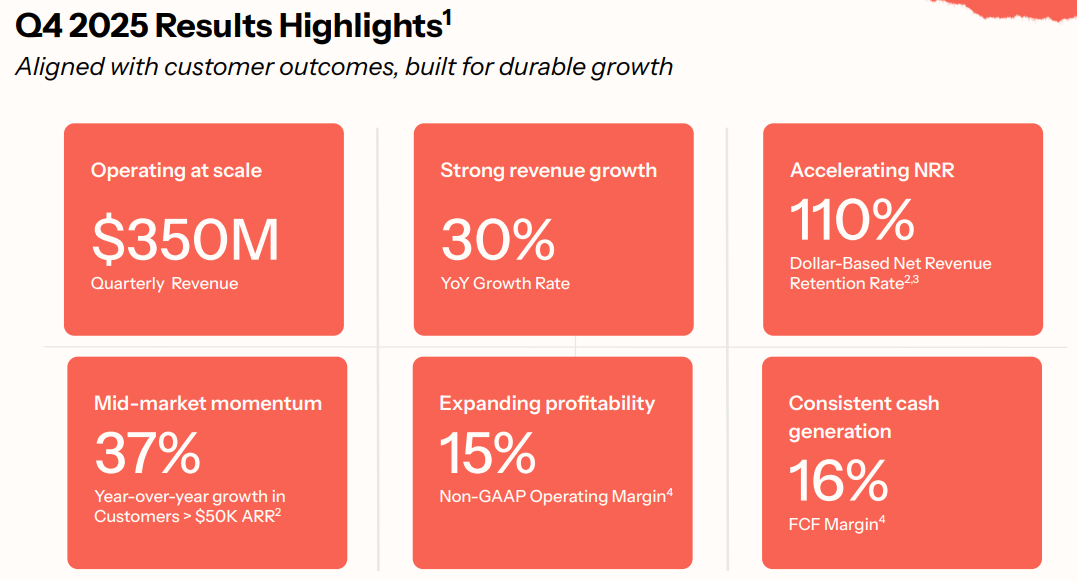
Q4 was a breakout quarter for Klaviyo. Revenue rose 30% year over year to $350.2 million, well ahead of expectations, while non-GAAP operating income reached $51 million, or a 15% margin, with strong free cash flow generation. Gross margin held at 73%, even with the expected seasonal mix shift toward SMS and WhatsApp, and free cash flow surged 61% year-over-year to $87 million.
Source: Klaviyo (Earnings Presentation)
The full-year results were equally strong. Klaviyo grew 2025 revenue by 32% to $1.2 billion, delivered a 14% non-GAAP operating margin, and increased free cash flow 35% to $200.4 million, or a 16% margin.
The bigger takeaway is that Klaviyo’s results continue to show a wide gap between market fears and operating reality. The company has now beaten revenue and EPS expectations for eight straight quarters.
Guidance
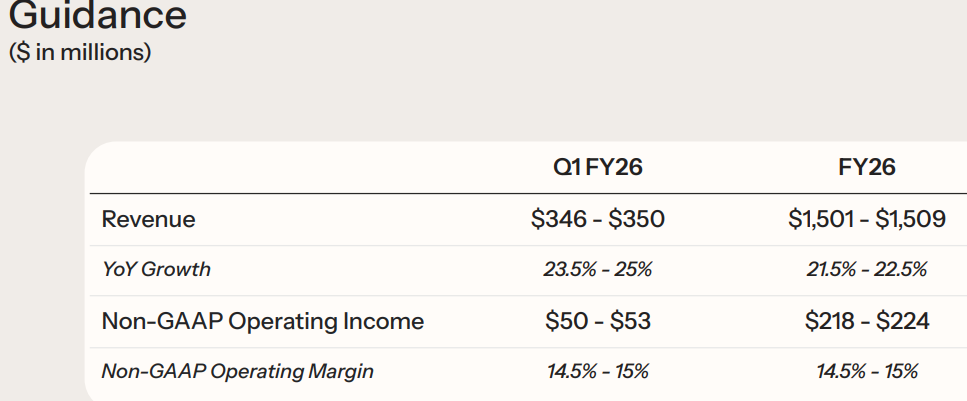
Management’s 2026 outlook appears fairly conservative. Klaviyo guided to $1.50 billion to $1.51 billion of revenue, implying roughly 22% year over year growth, along with non-GAAP operating income of $218 million to $224 million and a non-GAAP operating margin of 14.5% to 15%.
Source: Klaviyo (Earnings Presentation)
The headline revenue deceleration from 32% to roughly 22% looks sharp, but this is the law of large numbers at work and, in some ways, expected.
Notably, this guidance does not appear to assume any meaningful contribution from newer AI-related initiatives such as Marketing Agent, Customer Agent, the ChatGPT integration, or the Google partnership. That leaves room for upside if adoption ramps faster than expected, even though these products are currently contributing very little to revenue.
What Could Drive Klaviyo Higher
Main Risks and Headwinds
Bottom Line
Klaviyo’s selloff over the past year appears driven more by sector-wide AI fear than by any real break in the business. The fundamentals remain strong: 32% revenue growth, first-ever GAAP profitability, improving NRR, rising enterprise traction, and $200 million in free cash flow.
Analyst sentiment has also turned more constructive, with upward revisions far outpacing downward ones in recent months. Fifteen analysts revised their earnings upwards versus two downward revisions for the past 90 days. At roughly 3x forward EV to revenue, with nearly $1 billion in cash, a $500 million buyback underway, and AI upside not yet reflected, the risk-reward looks attractive despite real but well-understood risks such as Shopify concentration and margin pressure from SMS.
Welcome to edition 111 of Buyback Wednesdays, a monthly series that tracks the top stock buyback announcements during the prior month. The companies in the list below are the ones that announced the most significant buybacks as a percentage of their market caps. They are not the largest buybacks in absolute dollar terms. A word of caution. Some of these companies could be low-volume small-cap or micro-cap stocks with a market cap below $2 billion.
As majority of their companies reported their fourth quarter earnings, the number of companies announcing share buybacks in February has gone up significantly to 185, compared to 75 in the previous month.
1. GD Culture Group Limited (GDC): $3.95
On February 18, 2025, the Board of Directors of this AI marketing platform announced that it had approved a new $100 million stock repurchase agreement, equal to around 48% of its market cap at announcement.
| Market Cap: $218.67M | Avg. Daily Volume (30 days): 53,994 | Revenue (TTM): N/A |
| Net Income Margin (TTM): N/A | ROE (TTM): 3.26% | Net Cash: $0.96M |
| P/E: 12.35 | Forward P/E: N/A | EV/EBITDA (TTM):6.71 |
2. ZoomInfo Technologies Inc. (GTM): $6.31
On February 9, 2025, the Board of Directors of this Go-to-market platform announced that it had approved an additional $1 billion stock repurchase agreement, equal to around 43% of its market cap at announcement.
| Market Cap: $1.98B | Avg. Daily Volume (30 days): 7,947,822 | Revenue (TTM): $1.25B |
| Net Income Margin (TTM): 9.94% | ROE (TTM): 7.76% | Net Debt: $1.6B |
| P/E: 17.26 | Forward P/E: 12.47 | EV/EBITDA (TTM): N/A |
3. Empery Digital Inc. (EMPD): $4.19
On February 2, 2025, the Board of Directors of this electric off-road powersport vehicles manufacturer announced that it had authorized an additional $50 million stock repurchase program, equal to around 28% of its market cap at announcement.
| Market Cap: $152.10M | Avg. Daily Volume (30 days): 938,942 | Revenue (TTM): $2.62M |
| Net Income Margin (TTM): N/A | ROE (TTM): -39.41% | Net Debt: $30.04M |
| P/E: N/A | Forward P/E: N/A | EV/EBITDA (TTM): N/A |
4. Salesforce, Inc. (CRM): $194.91
On February 25, 2025, the Board of Directors of this customer relationship management company authorized a new $50 billion stock repurchase program that became effective immediately, equal to around 27% of its market cap at announcement.
| Market Cap: $183.48B | Avg. Daily Volume (30 days): 11,026,452 | Revenue (TTM): $41.53B |
| Net Income Margin (TTM): 17.96% | ROE (TTM): 12.37% | Net Cash: $2.83B |
| P/E: 25.91 | Forward P/E: 14.13 | EV/EBITDA (TTM): 15.27 |
5. Dana Incorporated (DAN): $32.11
On February 11, 2025, the Board of Directors of this automotive drivetrain manufacturer authorized an additional $1 billion share repurchase program, equal to around 26% of its market cap at announcement.
| Market Cap: $3.57B | Avg. Daily Volume (30 days): 1,762,566 | Revenue (TTM): $7.50B |
| Net Income Margin (TTM): 1.13% | ROE (TTM): -6.44% | Net Debt: $3.04B |
| P/E: N/A | Forward P/E: 13.09 | EV/EBITDA (TTM): 12.09 |
If you are reading this article and have not signed up to receive such articles by email, please sign up for our IA Plus, IA Premium or IA Professional service here. If you are an existing subscriber, you can log in to the InsideArbitrage.com website to adjust the kinds of articles you receive by email by turning on or turning off specific categories of articles.
Disclaimer: Please do your own due diligence before buying or selling any securities mentioned in this article. We do not warrant the completeness or accuracy of the content or data provided in this article.